One thing that stood out to me from Dr. Irvine’s lecture was how much more complicated modality in education has become. Before watching the video I mostly thought of learning as either face-to-face or online. However, I learned that there are many different ways to deliver education, including hybrid, blended, and multi-access learning. I also found it interesting that Hybrid can have two meanings: on a program level it means to have a mix of online and face-to face-courses while on course level it means to have a mix of online and face-to-face.
The video also made me think about how only offering a course face-to-face can create many disadvantages for some learners. Dr. Irvine discusses many limitations for students such as where they live, health concerns, disabilities, caregiving responsibilities, or mental health challenges. For example, someone living in a remote or rural community may have to travel long distances just to attend class. Similarly, students with a disability where they feel like they are getting discriminated against or bullied but still have to go regardless due to there being no online option to take the course. One idea I found particularly interesting was the concept of cyberproxy technology which allows learners to remotely participate in physical learning spaces and interact with others almost as if they were there in person. It made me realize that accessibility is about much more than simply offering a course online.
I was also surprised by the learner preference data that Dr. Irvine shared. While face-to-face learning was the most common first choice overall, with 54% of learners selecting it as their preferred mode, the preferences varied quite a bit depending on the group being examined. Even though face-to-face ranks quite high for first choice it drops down significantly for second, third and fourth.
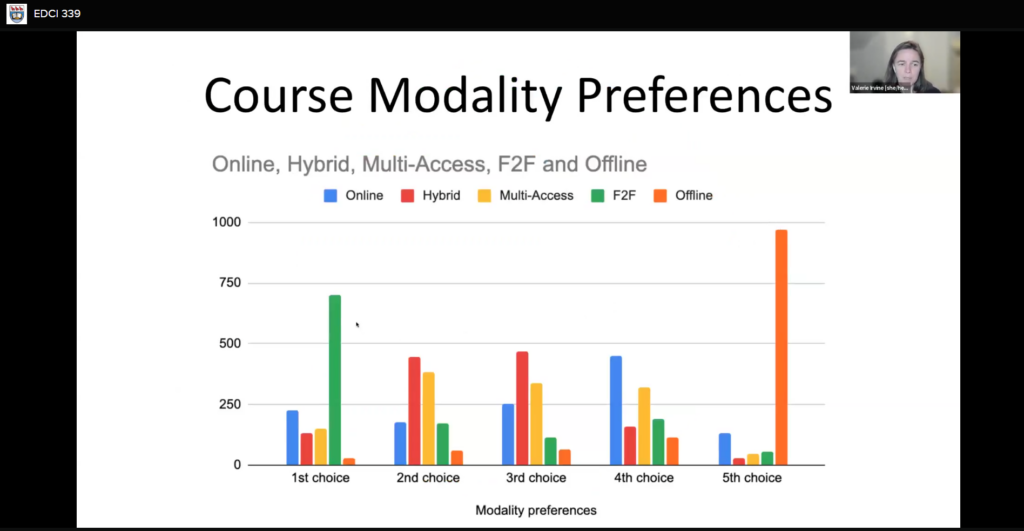
Students with caregiving responsibilities and rural learners were more likely to prefer online learning, while many first-year, international, and English as an Additional Language learners preferred face-to-face. Learners with disabilities or chronic health conditions also tended to prefer face-to-face learning overall, although Dr. Irvine pointed out that it depends on the disability/health issue and some require in person instructions. One statement that really stuck with me was when she said that whenever institutions choose a single mode of delivery, they are marginalizing some learners. I had never really thought about it that way before.
Personally when thinking about the future of modality in education, I think flexibility is going to become even more important. I don’t think face-to-face learning will disappear because many students still value the social connections, community, and support that come from being on campus. Online and multi-access options make education more accessible for people balancing work, caregiving responsibilities, health concerns, long commutes, or other challenges. My prediction is the future will include giving learners more choice rather than forcing everyone into a single mode of learning. Instead of asking whether education should be online or face-to-face, I think the more important question is how we can design learning experiences that allow more people to participate and succeed.
Leave a Reply
You must be logged in to post a comment.